October 2009
Shared objectives for a major project are often every bit as important in achieving on time, on budget outcomes for major infrastructure projects as is the -
correct selection of the technologies needed to make the project work.
A commitment to shared objectives - with the trust and flexibility to accommodate inevitable project changes without recrimination and contractual cost blowouts - can produce major benefits in savings of money and time and achieving ongoing operational efficiencies.
Such was the case recently in major water
reclamation and water treatment projects
for the Coffs Harbour City Council in which
K E Brown was a supplier to process and
manufacturing industry specialists CNF
and Associates, a member of the Coffs
Infrastructure Alliance Partnership. Six
K E Brown custom-built motor control
centres and seven especially designed
PLC boards were involved altogether
in the two projects, the scale of which
dwarfs the facilities they replace.
The Alliance - comprising Abigroup, John Holland, GHD, Aquatec Maxcon, CNF and Serck - this year completes the Coffs Harbour Water Reclamation Plant, worth more than $90 million, and the Coffs Harbour Water Treatment plant, worth more than $55 million.
The water reclamation plant (WRP) replaces the current sewage treatment plant, built in the 1960s, with a more efficient facility that can ensure a higher standard of water treatment and deal with the greater capacity needed as the population of the city grows. The state of- the-art water treatment plant (WTP) will assist the council to safeguard on the quality of water drawn from new sources as the district grows.
"Even though K E Brown acted as a supplier to a single member of the alliance, they voluntarily assumed a commitment to the Alliance's objectives and ideals of commitment for the project. While theirs was a sub-contractual role, their preparedness to think beyond their obligations and to act within the collective spirit was an asset to our company's progress as a member of the alliance, said CNF and Associates Principal Les Nador.
"Given the size of the project and the fairly demanding schedules extending from 2006 to early 2009 it was vital from the outset that participants in the project were focused on the overarching goals expressed in the Coffs Infrastructure Alliance Policy Charter. This important document, signed by all parties, set out our shared Mission, Performance Objectives and Relationship Objectives, which includes open, honest and timely communication and conduct which fosters trust and respect,".
"When working with suppliers we valued not only at their ability to deliver technology to do the best job cost-efficiently - which was vital, of course - but also to participate within in the spirit of the Charter, which K E Brown did.
"They won the business through an exacting open tender specification process, which was a very healthy and demanding one. In each case for which we wrote a specification, it was completely open and subject to the highest standards of probity, as agreed by the Alliance.
"In each case, K E Brown won on the basis of the basis of cost, proven technology and their established quality - and always they are keen to co-operate and to build relationships, which makes us very happy to deal with them.
"An harmonious relationship is important because when you go out to specs on a big project, you do so knowing that it is likely they will be changed along the way as the overall design changes to achieve the best result. That's where you can strike trouble if people aren't committed to a shared outcome, but rather are prone to get bogged down in disputes.
"K E Brown set out to be flexible, to negotiate these changes harmoniously, even where it involved delays for them. They are straight shooters - they always manage to achieve outcomes acceptable to all parties.
"They are good to work with because they are very flexible - even in one case where we had to delay delivery for up to some months. With uncommitted suppliers, situations such as that have the potential to get very nasty, so there is a large amount of trust involved."
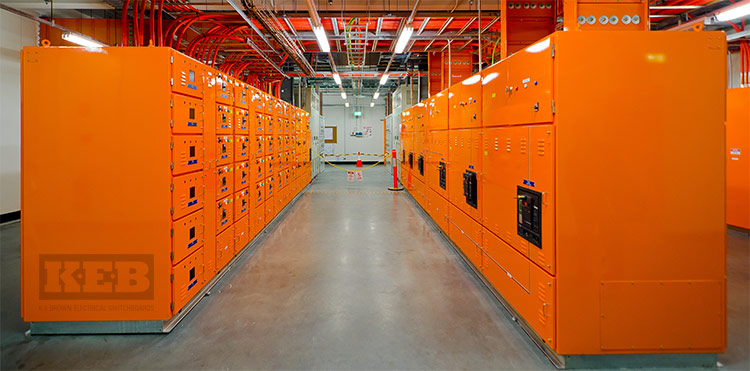
K E Brown supplied motor control centres and PLC boards governing more than 120 motors involved in the front half and back half of the WRP. These involved, respectively, the screening, grit, sludge and biological plant and, in the back half, the disinfection and filtration outlet. Motors included direct online and variable speed drives, with occasional soft-starters.
K E Brown technology installed in the Water Treatment Plant included four motor control centres and five PLC boards. These control more than 120 motors involved in processes including liming, initial water pumping station, dissolved air flotation and filtration, sludge and treated water pumping station. PLCs were networked in a similar way to the water reclamation plant.
A feature of the WTP control system is its ability to switch between a simple filtration process when water turbidity is low, to DAF (dissolved air flotation) processes and filtration (DAFF) when water turbidity warrants further treatment. This saves both energy and chemicals.
K E Brown Production Manager Joe Lopez says the compact motor control centres are designed for efficient operation and servicing, with thermoscanners operating through their covers so checks can be performed without having to take power off their boards.
The project was completed on budget - within 5 per cent of estimate - and on time. Even with the high demand for technical skills prevailing throughout the project, staff turnover was low with a high commitment to the job.
"KEB came in and shared the Alliance principles from the outset. They had no strict contractual obligation to do that but they did it anyway, which we greatly appreciated and which contributed in no small measure to the successful outcome," says Les Nador.