Switched On! Ideas, Developments, Solutions from K E Brown

KEB's Sean Peacock with proven switchboard technology

November 2008


Shock tactics pay rich double dividend in safety and performance


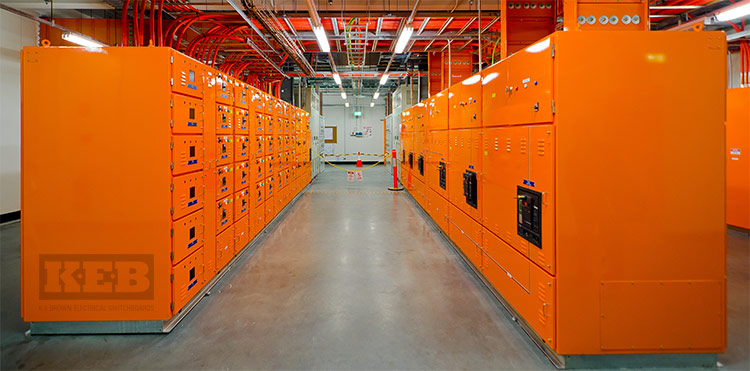
Switchboards are one of those vital pieces of industrial and commercial technology that no-one notices unless something goes wrong.


KEB's Sean Peacock with proven switchboard technology

Only then do owners appreciate just how dependent they are on the rugged reliability of this electrical distribution technology to feed current to vital functions of their business - such as computing, banking, data processing, manufacturing, industrial processing, lighting, lifts and emergency services - in fact, everything electrical in a building.

We take them so much for granted that few people understand what can happen if switchboard manufacturers don't test their technology rigorously to ensure they can withstand major power faults. In some major metropolitan centres, these faults can surge up to 63 kA - enough to knock out under-performing switchboards and bring industry and commerce to a dead stop.

Because such clients demand the highest standards of reliability to safeguard their operations, K E Brown recently instituted its own programme of research and development testing that went far beyond the mandatory and usual requirements - and surprised itself with the results.

Most manufacturers test only for project specific performance, while we wanted to go a big step further by testing a whole new generation of our switchboard technology. We also wanted to test new switchboard materials, such as Fibon glass polymer fibre busbar supports and Cu-Flex braided conductors.

Testing was conducted at the Sydney facilities of Testing and Certification Australia, where switchboards can be tested to the point of destruction and beyond. The switchboard selected for this rigorous treatment was a 2000A rated type, which, in addition to withstanding sudden overload,

was subjected to testing for temperature rise that could cause long-term damage and result in unreliable and unsafe performance.

We wanted to see how far we could go beyond the standard 63 kA for one second, so we could demonstrate safety, robustness and ability to handle any fault conditions predictable on any site.

When we got up to 63 kA nothing was happening, so we turned it up some more. At 80, still no problems. We just kept winding it up until we were at 100, when we decided that discretion was the better part of valour - we had well and truly proved what we set out to do.

Not only did the switchboard as a unit stand up to this type of abuse - far more than it could expect in normal service - but also the new materials survived a real baptism of fire. The Fibon material, which is used to replace Permali wood as bus bar supports, was outstanding.

The Cu-Flex material, from NHP, also performed outstandingly well, handling everything we could throw at it and coming up every bit as good as the solid copper alternatives usually employed in connections coming off the bus bar.

Again, the customer benefits of this are high margins of safety combined with lower cost of production. Cost savings without quality are of no interest to us, but it is a very different matter where we can get advances in technologies that are also cost-efficient.


...while testing reveals a poor choice (Not a KEB Switchboard!).

...while testing reveals a poor choice (Not a KEB Switchboard!).